Review · PRAGUE
Prague Renaissance and Baroque Gardens Walking Tour
Prague hides some of its best stories behind garden walls. This three-hour walk links the Prague Castle Gardens, Wallenstein Garden, and Vrtba Garden through the city’s changing artistic and political life. I like the Italian Renaissance details, especially the Singing Fountain and the old Orangery, and I like the contrast between grand public gardens and Vrtba’s quiet terraces. The main drawback is the route’s steep, narrow stairs, while garden admission fees are extra.
I also like that this is a history walk with plants, fountains, statues, and views rather than a simple list of pretty courtyards. Guide Miriam has been praised for being informative and relaxed, a useful combination on a route that covers a lot in three hours. If you need a slow pace or have mobility concerns, book a private version so the route can be adjusted.
Key things to know before you go
- Italian Renaissance roots: Learn how Emperor Ferdinand I brought Italian architects and gardeners to Prague in the 1500s.
- A working Orangery: See where figs, almonds, oranges, and lemons were first grown in Central Europe.
- The Singing Fountain: Listen for the bell-like sound made when water falls into the bronze basin.
- Wallenstein’s theatrical garden: Look for albino peacocks, Mannerist statues, a grotto wall, and mythical fountains.
- Vrtba’s rooftop views: Climb through a 1720 Baroque garden to a marine-themed grotto and broad views across Prague.
Why Prague’s gardens tell a different story
Prague’s churches, palaces, and public squares usually get the attention. Gardens tell a quieter story, but they can reveal just as much about power, faith, fashion, and science.
The earliest medieval gardens in the city were mainly useful places. Monks and other residents grew herbs for food and medicine. A few Gothic cloisters still preserve traces of this practical tradition. Vineyards on the hills around Prague also predate Charles IV, showing that cultivation was part of the city’s surroundings long before grand palace gardens appeared.
The big change came in the 1500s. Emperor Ferdinand I wanted Prague to look more like the Italian courts he admired. He brought Italian architects and gardeners north of the Alps, introducing formal Renaissance ideas to Bohemia.
That background gives the walk a clear thread. You are not just moving from one garden to another. You are watching Prague shift from useful medieval planting spaces to carefully designed places for royal display, noble pleasure, science, and political theater.
I find that context especially useful because garden details can otherwise seem random. A straight terrace, a statue of a classical god, or an imported orange tree all make more sense when you understand who paid for them and what they wanted to say.
More Garden Tours in the world:
- Paris: Versailles Palace and Gardens Full Access Ticket
★ 4.6 · 41,579 reviews - Versailles: Skip-the-Line Tour of Palace and Gardens Access
★ 4.7 · 10,429 reviews - Marrakesh: Majorelle Garden Entry Tickets
★ 4.5 · 9,651 reviews
Ferdinand I and the Royal Gardens
The tour begins at the Prague Castle Gardens, where Ferdinand I’s Italian ambitions become visible. He commissioned the Royal Gardens in the 1500s and hired a formidable group of Italian specialists to create a courtly setting unlike anything Prague had seen before.
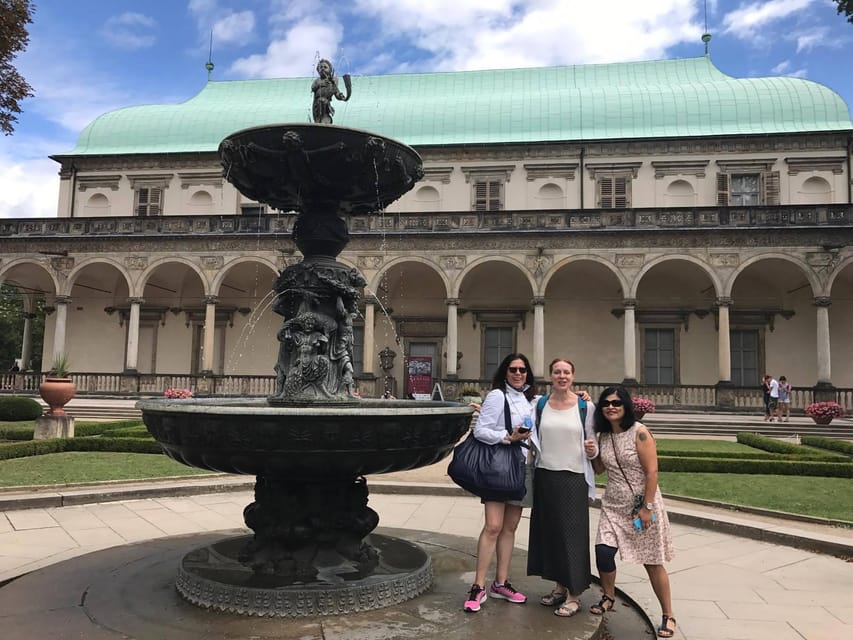
The centerpiece is the Belvedere Summer Palace, built as a gift for Queen Anne. She died before the building was completed, which gives the palace a particularly poignant story. One relief shows Ferdinand presenting his wife with a flower from the Royal Gardens, a graceful image that feels more personal than the usual royal propaganda.
The building was designed by the Italian architect Paola della Stella. It is often described as the finest Renaissance structure outside Italy, and the setting helps explain why. The palace is not an isolated building. Its proportions, garden front, and position within the Royal Gardens all work together.
In front of the palace is a small Giardinetto, or pleasure garden. Here you see the Singing Fountain, cast in bell bronze in 1564. Water falling into its basin creates a ringing sound, which explains the name. It is a small feature, but it captures the Renaissance taste for combining art, engineering, and entertainment.
You should listen carefully when the guide explains it. The fountain is easy to treat as another old object, yet its sound was part of the original experience. Royal gardens were designed to surprise the senses, not simply to provide a pleasant view.
The Castle Gardens also introduce the tour’s main theme: imported ideas adapting to local conditions. Italian classicism arrived in Prague through buildings, planting schemes, fountains, and garden geometry. The result was not an exact copy of Italy, but a Central European version of Renaissance court culture.
The Fig House, Orangery, and exotic plants
The Fig House and Orangery add a more practical side to the royal project. These structures were used to grow figs, almonds, oranges, and lemons, plants that were not naturally suited to Prague’s climate.
That makes this part of the tour more than a story about decoration. A royal garden could be a place for status, but it could also function as a testing ground for horticulture. Growing Mediterranean fruit in Central Europe required skill, money, and careful protection from cold weather.
You may find this stop especially interesting if you enjoy the history of food and trade. Citrus trees and figs were not ordinary garden plants in Prague. Their presence showed the reach of the court and its ability to import both plants and expertise.
The walk also touches on the arrival of tulips in Europe. Tulips, previously unknown in Europe, reached the Royal Gardens as an exotic gift from the Sultan of Constantinople. This detail gives you a sense of how plants traveled through diplomatic and commercial networks.
It is easy to forget that a garden can be a record of international exchange. Long before modern garden centers, a new plant could signal contact with a distant court. A tulip was not just a flower. It was a novelty, a diplomatic object, and a mark of refined taste.
Stag Moat and the descent below Prague Castle

After the Royal Gardens, you approach the Stag Moat before crossing through a castle courtyard. The route then descends by the Bull Stairs toward the South Gardens.
This is where the physical demands of the walk become clear. The route includes stairs that can be narrow, steep, and uneven in places. You should wear comfortable shoes and be ready for repeated climbs and descents. The tour lasts three hours, but the effort comes from the terrain rather than from a long, flat distance.
The South Gardens include the Garden of Paradise and the Garden on the Bulwark. Their names reflect the grand language often used for court gardens, where planting spaces were designed to suggest order, pleasure, and control.
I like this section because it changes your view of Prague Castle. From the main castle routes, the complex can feel like a collection of monumental buildings. Moving through its gardens shows how the palace was also designed for leisure, ceremony, and views across the city.
The descent through the terraced gardens is also visually rewarding. You move gradually down the hill rather than simply leaving the castle behind. Terraces connect the upper royal grounds with the noble gardens below, creating a physical link between the castle and Lesser Town.
Same place, a different sort of green day out:
- Vienna: Schönbrunn Palace & Gardens Skip-the-Line Tour
★ 4.7 · 7,739 reviews - Granada: Alhambra & Gardens Tour w/Nasrid Palaces Option
★ 4.2 · 7,022 reviews - From Paris: Versailles Palace & Gardens with Transportation
★ 4.6 · 6,222 reviews - Vienna: Skip-the-Line Sisi Museum, Hofburg and Gardens Tour
★ 4.8 · 5,918 reviews
Wallenstein Garden and the politics of display
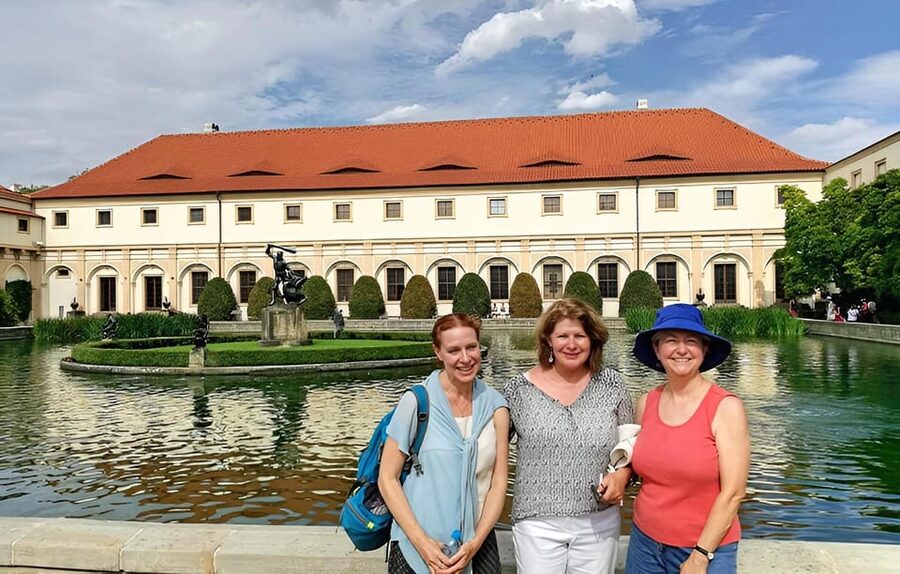
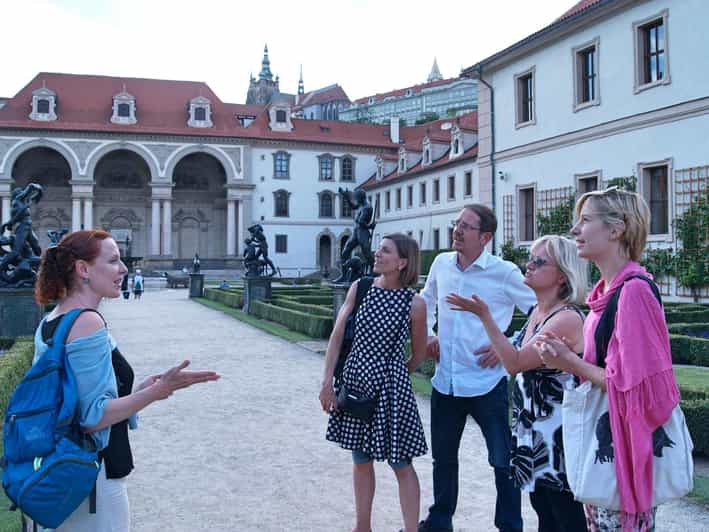
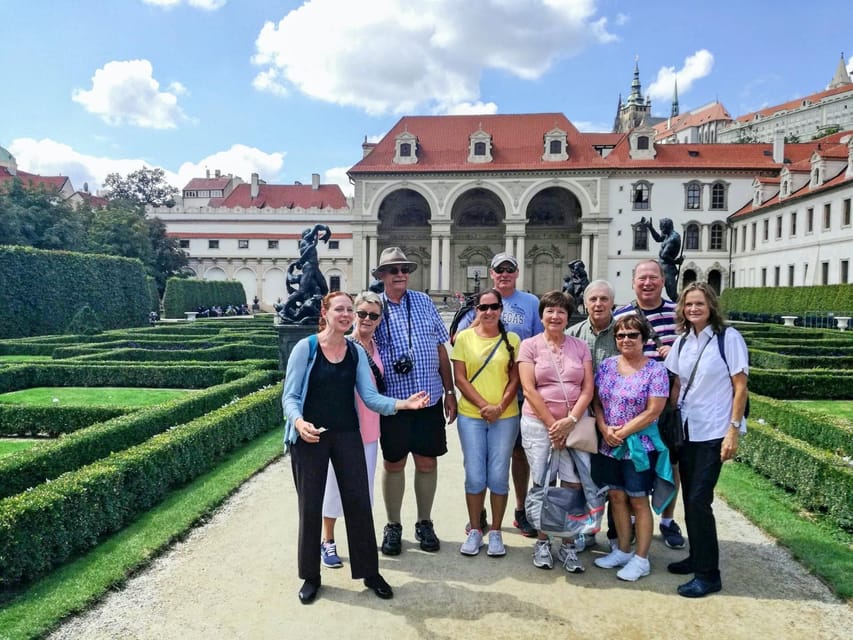
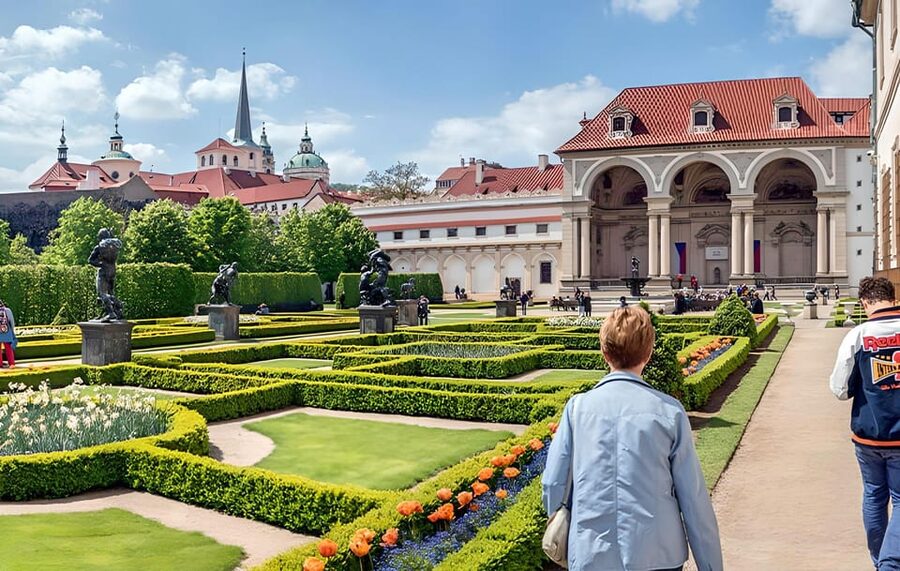
At the bottom of the hill, the tour reaches Wallenstein Garden. The scale changes at once. This is a grand Baroque garden connected with Albrecht von Wallenstein, one of the most powerful and dramatic figures of the period.
The garden includes Mannerist statues, mythical fountains, a grotto wall, and albino peacocks. Each feature adds theatrical force. The white peacocks are memorable, but they are only one part of a setting designed to impress visitors and communicate power.
Wallenstein’s story gives the garden its sharper edge. He was not simply a wealthy noble commissioning a pleasant retreat. His ambitions were tied to the politics and warfare of his time, and the garden reflects the confidence of a man who wanted his position understood.
The guide explains the move from Renaissance classicism to Baroque ideas. Renaissance gardens favored balance, geometry, and references to classical antiquity. Baroque design pushed toward drama, movement, surprise, and emotional effect.
You can see that shift in the garden’s combination of architecture, sculpture, water, and theatrical scenery. The grotto wall suggests a cave from nature, but it is carefully made. The fountains turn water into spectacle. The statues populate the garden with mythological figures, making the space feel like a stage.
This is one of the strongest sections for visitors interested in architecture and power. Wallenstein Garden is attractive, but it is not merely decorative. It shows how a nobleman could use a garden to present himself as cultivated, wealthy, and connected to the classical world.
The garden also offers a useful contrast with the Royal Gardens. Ferdinand I used Renaissance design to express courtly refinement and international ambition. Wallenstein’s garden carries a more forceful Baroque mood, full of movement and visual statements.
Vrtba Garden, a small Baroque world above Lesser Town
The final major stop is Vrtba Garden in Mala Strana, or Lesser Town. Dating from 1720, it is a walled Baroque garden built on a compact site.
Vrtba is easy to miss if you are exploring Prague on your own. Its entrance does not announce a huge public park. Inside, the garden climbs in terraces, with each level offering a new angle on the space below and the city beyond.
This is where the walk’s theme comes together. Vrtba shows how noble garden design worked in the 18th century, when a relatively small enclosed garden could still express status, taste, and control. The setting feels more intimate than Wallenstein Garden, but the design is no less deliberate.
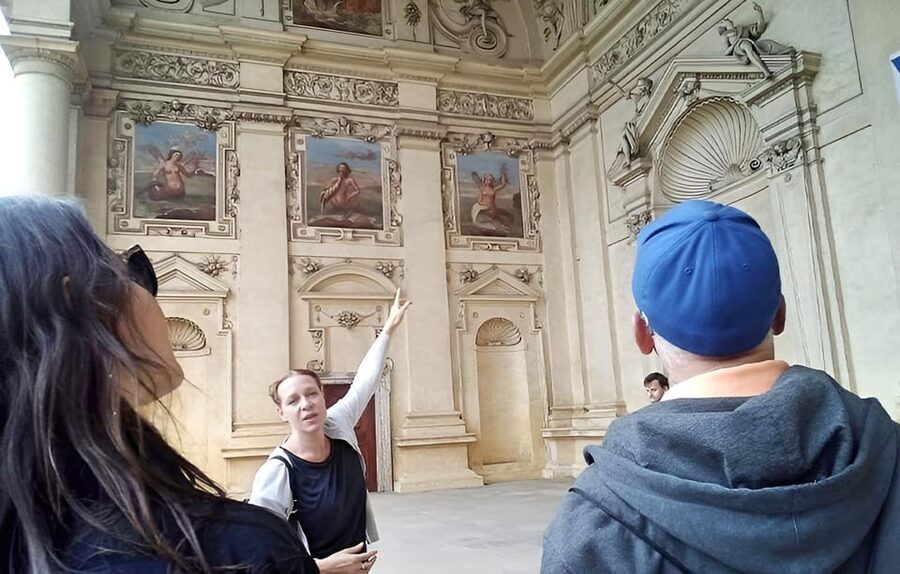
As you climb toward the top courtyard, look for the marine-themed grotto. This playful feature fits the Baroque appetite for illusion and surprise. Stone, water, and decorative forms create an artificial cave that turns the garden into a little world of its own.
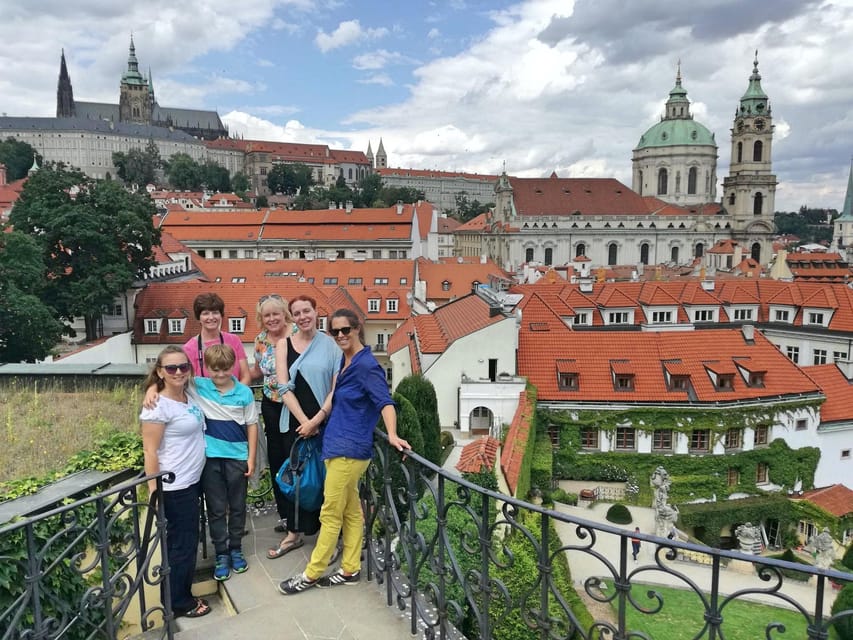
The reward at the top is the view across Prague. You can see the city from a different angle, with the garden terraces below and the broader cityscape beyond. I consider this one of the best reasons to include Vrtba on a garden tour. The views are not an afterthought. They are part of how the garden was meant to be experienced.
Vrtba can be especially satisfying after the larger Royal and Wallenstein gardens. The tour moves from royal ambition to noble display, then finishes in a more enclosed and personal setting. The scale gets smaller, but the design becomes easier to read.
What the $123 price really includes
The tour costs $123 per person for three hours. That is not a bargain-priced city stroll, especially because admission to the gardens beneath Prague Castle and Vrtba Garden is not included.
Still, the price is easier to assess if you value interpretation rather than simple entry. You are paying for a historian guide who connects architecture, gardening, politics, religion, horticulture, and international exchange. Without that explanation, you might see a fountain, an Orangery, or a terrace without understanding why it matters.
The value is strongest for someone who has already seen Prague’s main sights and wants a more focused subject. It is also useful if you enjoy architecture, garden design, royal history, or unusual city details.
The cost may feel harder to justify if you only want a casual walk through attractive green spaces. You will also need to budget for the two admission fees listed above, with the exact amounts not provided here.
Private and small-group formats are available. A private tour can offer better value if you need a custom pace, especially because the route includes steep and narrow stairs. It also gives you a better chance to focus on the parts you care about most.
Timing, meeting point, and practical advice
The meeting point is at the door of Bagel Lounge Malostranska. Starting times vary, so check availability before booking.
The tour is offered in English with a live guide. It lasts three hours and includes a guided history walk, but not the garden admission charges.
I would wear shoes with a firm sole and avoid carrying a heavy bag. The route moves up and down the castle hill, and some stairs can feel tight. If stairs are difficult for you, contact the provider about a private tour before booking. The regular route may be adapted by leaving out some sites and giving more time to others.
The cancellation policy is reasonably flexible. You can cancel up to 24 hours before the start for a full refund, and you can reserve now and pay later. Those terms help if your Prague schedule is still shifting.
Who will enjoy this garden walk most?
I recommend this tour for you if you want to see Prague through a specific theme instead of ticking off major buildings. It suits anyone interested in Renaissance and Baroque art, royal courts, horticulture, fountains, statues, or the way political ambition appears in design.
It is also a good choice for repeat visitors. The gardens provide a quieter side of central Prague and add meaning to places you may have already passed without entering.
Families with older children may enjoy the peacocks, fountains, grotto, and story of imported plants. Younger children may find three hours of garden history too long, especially with the stairs.
You should think twice if you want a flat route, dislike historical explanation, or want all entrance costs included in the price. The walk is active, and its value depends on your interest in context.
The strongest praise has gone to the guiding style. Miriam was described as both highly informative and relaxed, which is exactly what this route needs. You want someone who can explain Ferdinand I, Wallenstein, tulips, and Baroque design without turning the walk into a lecture.
Should you book the Prague garden tour?
Book it if you want a thoughtful look at Prague’s royal and noble gardens, and if you are comfortable with stairs. The combination of the Singing Fountain, Orangery, Wallenstein’s theatrical details, and Vrtba’s city views gives you a varied three hours.
I would be most likely to choose it after seeing Prague Castle itself, since the garden route adds context that the main interiors cannot provide. The price is fairly high and the admission fees are extra, but the historian guide gives the outing a clear purpose.
For a slower pace or mobility concerns, choose the private option and ask for a tailored route. For everyone else, this is a strong pick for seeing how Prague’s rulers used plants, water, sculpture, and architecture to show power and taste.
FAQ
How long is the Prague Renaissance and Baroque Gardens Walking Tour?
The tour lasts three hours.
What language is the tour offered in?
The tour is offered in English with a live guide.
Where does the tour meet?
You meet at the door of Bagel Lounge Malostranska.
Are garden admission fees included?
No. Admission to the gardens beneath Prague Castle and Vrtba Garden is not included.
Is the route suitable for people with mobility issues?
The regular route includes stairs that can be narrow, steep, and difficult. A private tour can be tailored to your limits and personal pace, with some sites left out if needed.
Can I cancel for a full refund?
Yes. You can cancel up to 24 hours in advance for a full refund.
Just added around the world
- Royal Horticultural Society: Harlow Carr Garden Ticket★ 4.7 · 14 reviews
- Zanzibar: Jozani Monkeys, Butterfly Garden & Reptile Park★ 5.0 · 2 reviews
- Yu Garden Shanghai Entry Tickets Booking And Trip★ 3.6 · 9 reviews
- York: Castle Howard House and Gardens – Self-Guided★ 4.8 · 120 reviews
- Xochimilco floating gardens, Coyoacan and UNAM murals★ 4.0 · 6 reviews
- York: Castle Howard Gardens and Grounds Entry Ticket★ 4.5 · 23 reviews
- Woodside: Filoli Historic House and Garden Entry Ticket★ 4.9 · 9 reviews
- Woking: Royal Horticultural Society Wisley Garden Ticket★ 4.7 · 24 reviews
Tours, compared.
Skip-the-Line Tour of Palace and Gardens Access
Read our review →
Schönbrunn Palace & Gardens Skip-the-Line Tour
Read our review →
Alhambra & Gardens Tour w/Nasrid Palaces Option
Read our review →
Skip-the-Line Sisi Museum, Hofburg and Gardens Tour
Read our review →
Skip-the-Line Schönbrunn Palace & Gardens Tour
Read our review →
Cooking Class, Market & Thai Herbs Garden Tour
Read our review →
Versailles Palace Guided Tour & Gardens Access
Read our review →