Review · PRAGUE
Private Prague Renaissance & Baroque Gardens Walking Tour
Prague keeps some of its best views behind garden walls. I like this tour for its private format and its sharp focus on Renaissance and Baroque design, not just famous buildings. I also like the unusual stories, from tulips sent by a Turkish sultan to exotic fruit grown for the royal court. The main drawback is cost: $397.36 is a serious outlay unless you can fill the group with several people.
You spend about three hours walking between royal gardens, palace courtyards, and terraced slopes below Prague Castle. A scholar guide, including guides such as Bonita, brings the details to life. You should be comfortable walking and climbing stairs, especially at Vrtba Garden, where the upper terrace requires a steep ascent.
What makes this private garden tour special
- The Queen Anne connection: Learn how Ferdinand I gave his wife a summer palace and garden complex, including an ornamental fig tree reference carved into the building.
- Early exotic gardening: See the Fig House and Orangery, tied to the first successful cultivation of exotic fruit trees in Central Europe.
- A bronze singing fountain: Visit the famous fountain in the Royal Garden and hear the story behind its name.
- Wallenstein’s theatrical garden: Find albino peacocks, mythological statues, artificial grottoes, and a dramatic fountain in the Senate gardens.
- Vrtba’s high terrace: Finish among Baroque statues and some of the finest views toward Prague Castle and the city.
- A genuinely private group: Only your party takes part, with morning and afternoon departures available.
Why Prague’s gardens deserve three hours
Many first-time visits to Prague focus on the Astronomical Clock, Charles Bridge, and Prague Castle interiors. Those sights matter, but the city’s gardens explain how its rulers and nobles lived around those monuments.
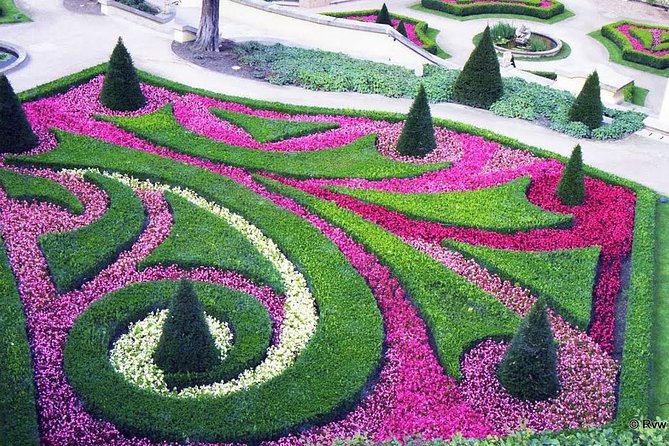
This tour links several different garden styles in one walk. You see the orderly ideals of the Renaissance, the theatrical effects of the Baroque, and the practical work of court gardeners who grew plants from distant lands. I like that balance. You are not simply ticking off attractive courtyards. You are watching Prague’s taste change over several centuries.
The private setup is important here. Gardens can look like a collection of statues and clipped hedges unless someone points out the symbols, planting experiments, and political stories. With your own guide, you can ask why a fountain is shaped a certain way, how the gardens relate to the castle, or which details are easy to miss.
The tour begins at Bagel Lounge Malostranská on Letenská in Lesser Town, unless you arrange pickup from a central hotel or flat. After meeting, the group takes tram 22 together to reach the Castle Gardens. That shared ride is part of the practical route, not an awkward transfer you need to organize yourself.
More Garden Tours in the world:
- Paris: Versailles Palace and Gardens Full Access Ticket
★ 4.6 · 41,579 reviews - Versailles: Skip-the-Line Tour of Palace and Gardens Access
★ 4.7 · 10,429 reviews - Marrakesh: Majorelle Garden Entry Tickets
★ 4.5 · 9,651 reviews
The Royal Garden and the first royal experiments
The Royal Garden began in the 1500s on the site of medieval vineyards. Its purpose changed the character of Prague Castle. Instead of being only a fortress and seat of power, the castle gained a cultivated setting for leisure, display, and botanical experiments.
Your guide explains how plants from faraway places were brought here and how gardeners tried to make them thrive in Central Europe. That makes the garden more than a pleasant green space. It becomes evidence of royal wealth, international connections, and serious horticultural ambition.
The Fig House and Orangery are especially interesting. They recall the effort to grow exotic fruit trees in a climate that did not make the job easy. If you enjoy gardens, architecture, or the practical side of court life, this section gives the tour much of its substance.
The Royal Garden visit is listed at about 15 minutes, so expect a focused introduction rather than a long, unhurried garden visit. You will want to listen closely because the time passes quickly.
Queen Anne’s Summer Palace in five focused minutes
Queen Anne’s Summer Palace is one of the clearest Renaissance buildings outside Italy. It was completed in the middle of the 16th century and is wrapped in ornamental and figurative decoration.
Look for the Tuscan capitals on the arcade columns and the reliefs showing mythology, hunting, and warfare. One relief depicts Ferdinand I offering Queen Anna a fig blossom, a small detail that connects the palace to the nearby garden and its exotic fruit-growing story.
The stop is listed at about five minutes. That sounds brief, but it works as an architectural pause within the wider garden route. You will not have time for a lengthy inspection of every relief, so keep your eyes on the facade and let the guide explain the key symbols.
Directly above the Stag Moat, the Ball Game Hall shows how royal buildings could change purpose over time. It was built in the mid-1500s for ball games, then later used as a riding school and stables.
This is another short stop, also about five minutes. It is best understood as part of the Royal Garden complex rather than as a separate major attraction. The value comes from seeing how court buildings served changing needs.
Wallenstein Garden, where the Baroque gets theatrical
Wallenstein Garden, also called Waldstein Garden, brings a different mood. The garden belongs to the Wallenstein Palace, built in the 1600s and now used by the Senate of the Czech Republic.
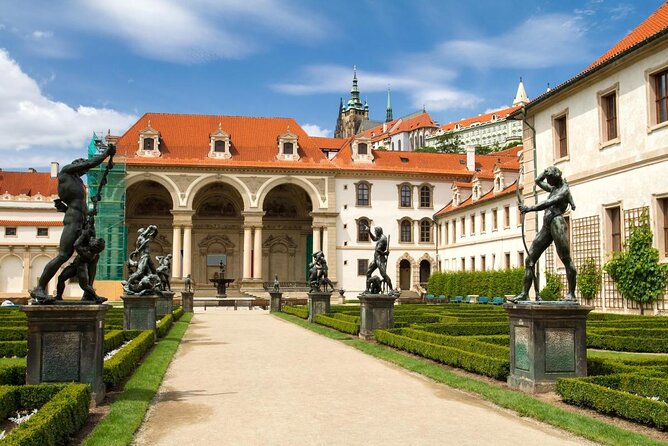
Its Italian-style plan includes an aviary, artificial grotto, mythological statues, and a fountain by Adrian de Vries. The design is not shy. Baroque gardens were meant to impress, and this one uses sculpture, water, stone, and planted spaces to create a stage-like setting.
The grotto is a particularly memorable feature. Its rough, artificial rockwork contrasts with the formal geometry elsewhere in the garden. That tension between controlled design and imitation nature is one reason the stop feels different from the Renaissance royal grounds.
You may also see the garden’s albino peacocks. They add a touch of oddity to an otherwise carefully planned setting, though animal sightings can never be guaranteed. The garden is open to the public as the grounds of the Czech Senate, and admission is free.
Allow about 25 minutes here. That is enough to see the main features with a guide, though you may wish the schedule allowed extra time for photographs.
Same place, a different sort of green day out:
- Vienna: Schönbrunn Palace & Gardens Skip-the-Line Tour
★ 4.7 · 7,739 reviews - Granada: Alhambra & Gardens Tour w/Nasrid Palaces Option
★ 4.2 · 7,022 reviews - From Paris: Versailles Palace & Gardens with Transportation
★ 4.6 · 6,222 reviews - Vienna: Skip-the-Line Sisi Museum, Hofburg and Gardens Tour
★ 4.8 · 5,918 reviews
The terraced gardens below Prague Castle
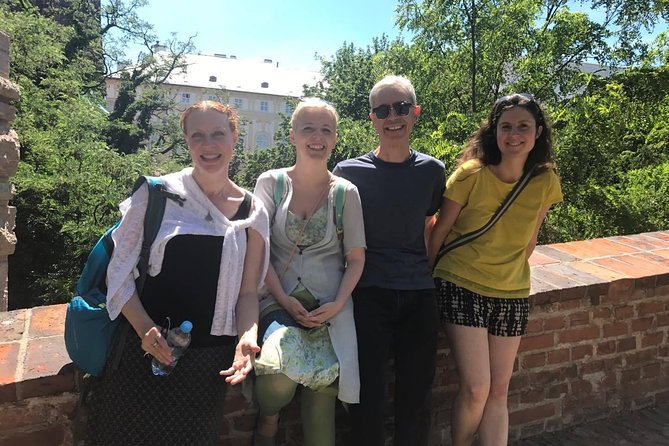
The route continues through the castle courtyards and the South Gardens and Garden of Paradise, then down through a series of terraced gardens on the slope below the castle.
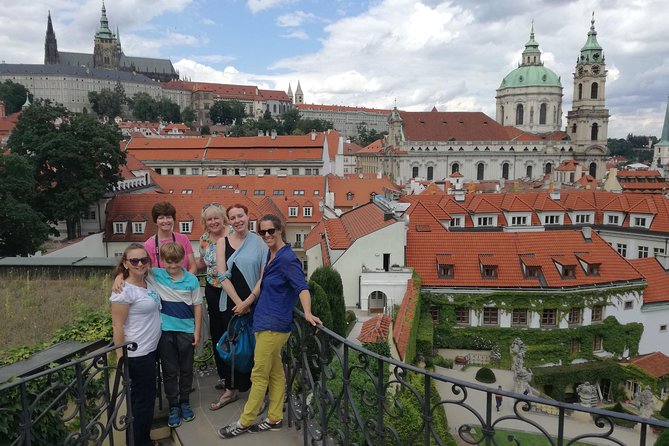
These gardens are valuable because they show Prague from changing heights. Instead of viewing the city from one fixed lookout, you move through a sequence of terraces, walls, stairs, and framed openings. The castle rises above you, while the Lesser Town and the wider city open out below.
This part of the walk also puts the different garden styles into context. The Royal Garden feels tied to court life and botanical display. The lower terraces use the steep hillside itself as part of the design. You can see how gardeners worked with Prague’s topography rather than treating the slope as a problem.
The walking is not entirely flat. The tour requires a moderate level of fitness, and you should wear shoes that handle stairs and uneven pavement comfortably. If you have trouble with climbs, tell the guide early so the private format can work in your favor.
Vrtba Garden and the best final view
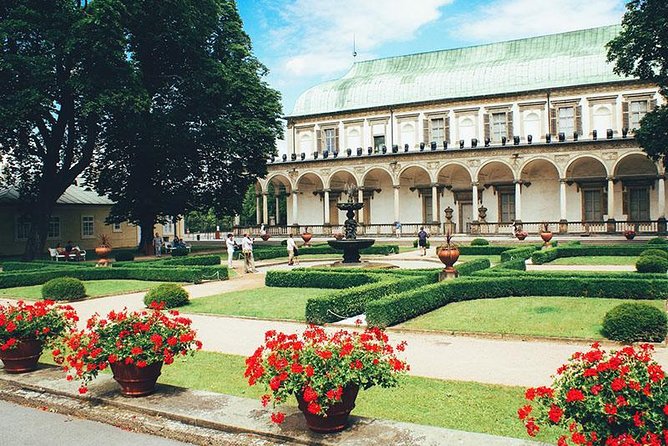
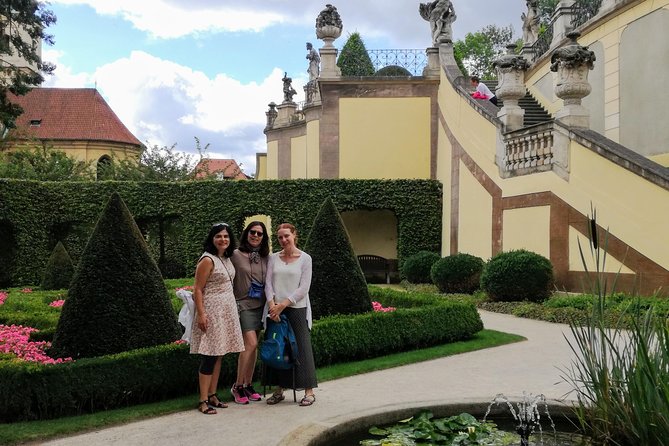
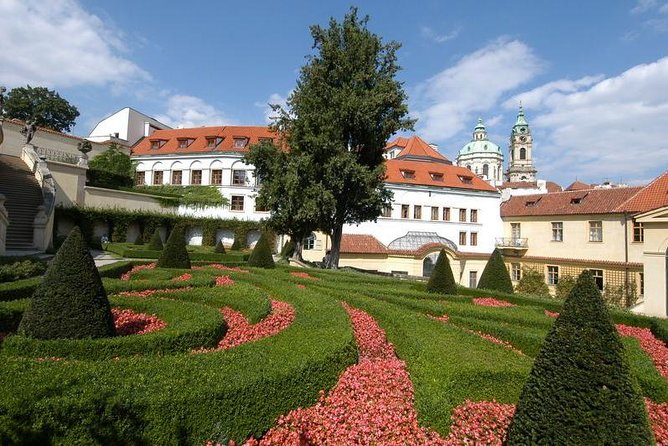
Vrtba Garden is the tour’s most exclusive-feeling stop. It is a Baroque walled garden from around 1720, decorated with original statuary and sculptural details. Its layout climbs the hillside in terraces, leading to an upper courtyard with views toward Prague Castle and the city.
The garden is small compared with a grand royal park, but that is part of its appeal. The enclosed scale makes the statues, stairways, and planted spaces feel carefully composed. The decorations also carry symbolic meaning, which your guide can explain better than a quick solo visit would.
At the top, the view is the reward. You get a broad look over Prague from a garden that many people miss. That combination of architecture, sculpture, and city outlook makes Vrtba a strong finish to the walk.
The visit requires steep stairs to the upper terrace. If climbing is difficult, you may wait below, or you can ask for a private route adjusted to your group. Vrtba admission is not included, along with admission to the gardens under Prague Castle, so budget for those extra fees.
The route information describes Vrtba as the final stop and places the finish in the heart of Lesser Town. The meeting details also identify Bagel Lounge Malostranská as the end point, so confirm the exact finish arrangement when you book, especially if you have another appointment afterward.
What the $397.36 price really means
The price is $397.36 per group of up to 10 people. At full capacity, that works out to about $39.74 per person. For two people, however, the cost is nearly $199 per person, which makes the tour far less attractive on price alone.
The value comes from the private scholar guide rather than from included admissions. You get a focused explanation of Prague’s gardens, the option of a morning or afternoon start, and the ability to ask questions without sharing the guide with a large group.
I would consider this a good value for a family or group of friends who can divide the fee. It is harder to justify for one or two people unless garden design, court history, and architecture are central interests. The two garden admission charges are extra, and the tour does not turn into a low-cost sightseeing option.
The private format also gives you some flexibility. The guide can tailor the experience if someone has trouble with the steep steps at Vrtba. That kind of adjustment is more useful than a generic promise of flexibility because the route has a known physical challenge.
Timing, transport, and practical details
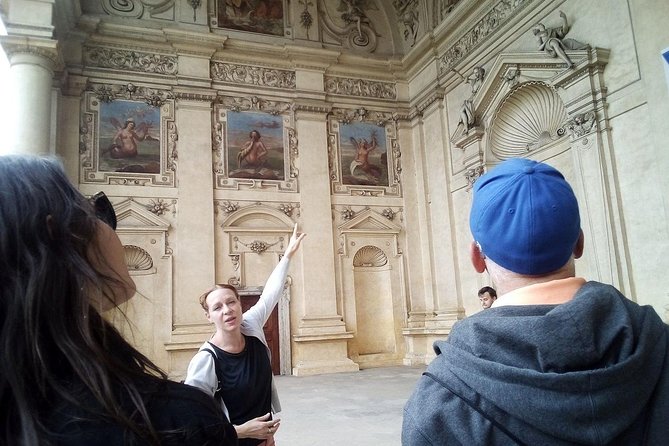
You can choose a morning or afternoon departure. A morning start may suit you if you want to see the gardens before a full day of sightseeing. An afternoon start can fit well after a slow breakfast or a visit to another Prague attraction.
The tour lasts about three hours. That includes the tram ride to the Castle Gardens and walking between several sites, so it is not three hours spent inside one garden. The pace should feel active, especially because the route includes slopes and stairs.
Pickup is offered from a central hotel or flat if you provide the address. Otherwise, meet in front of Bagel Lounge Malostranská at Letenská 118/1. The meeting point is near public transport, and the group takes tram 22 together after meeting.
The gardens close during the winter season from November through March. That seasonal closure is a major booking detail. If you are visiting Prague in winter, do not assume the tour will operate simply because the city’s other attractions are open.
Confirmation is provided at booking, and free cancellation is available if you cancel at least 24 hours before the start time. Changes or cancellations inside that window are not accepted for a refund.
Who will get the most from this walk
I would choose this tour if you want more than postcard views of Prague. It suits you especially well if you enjoy:
- Renaissance and Baroque architecture
- Garden design and sculpture
- Stories about royal households and court life
- Small, private tours with time for questions
- Viewpoints that are less central to the standard Prague route
Families and small groups can get good value if they share the fee. The tour also works for repeat visitors who have already seen Prague Castle’s main buildings and want a different side of the area.
It may not suit you if you want a relaxed stroll with no stairs, or if you prefer to explore gardens independently at your own pace. The schedule is fairly structured, and Vrtba’s climb can be uncomfortable for anyone with mobility issues.
The guide matters greatly. Bonita is specifically praised for explaining details and showing parts of Prague that are easy to miss. If she is available for your date, her approach may be worth requesting, though guide availability should be confirmed before booking.
Should you book the Prague garden tour?
Book it if you can share the group price and you care about the stories behind Prague’s gardens. The strongest parts are the private scholar guide, the unusual royal gardening details, Wallenstein’s eccentric statues and grotto, and Vrtba’s terrace view.
Think twice if you are watching every dollar, visiting between November and March, or avoiding steep stairs. For the right group, this is a smart way to connect several beautiful sites that are easy to overlook. It gives Prague Castle a more human scale, showing not only where rulers lived, but how they gardened, entertained, collected plants, and displayed power.
FAQ
How long does the Prague Renaissance and Baroque Gardens tour last?
The tour lasts approximately three hours.
How many people can join the private tour?
The tour is private and allows up to 10 people in your group.
Is hotel pickup available?
Pickup is offered from a central hotel or flat if you provide the pickup address. Without that information, meet your guide in front of Bagel Lounge Malostranská at Letenská 118/1.
What transportation is used during the tour?
After meeting the guide, the group takes tram 22 together to reach the Castle Gardens.
Are the garden admission fees included?
No. Admission to Vrtba Garden and the gardens under Prague Castle is not included. Wallenstein Garden and the Royal Garden are listed as free admissions.
Is the tour offered during winter?
The gardens are closed from November through March, so the tour is not available during that winter closure period.
Does the tour require a lot of walking or climbing?
You need a moderate level of physical fitness. Vrtba Garden includes steep stairs to the upper terrace, though you may wait below or ask for a route tailored to your group.
Just added around the world
- Royal Horticultural Society: Harlow Carr Garden Ticket★ 4.7 · 14 reviews
- Zanzibar: Jozani Monkeys, Butterfly Garden & Reptile Park★ 5.0 · 2 reviews
- Yu Garden Shanghai Entry Tickets Booking And Trip★ 3.6 · 9 reviews
- York: Castle Howard House and Gardens – Self-Guided★ 4.8 · 120 reviews
- Xochimilco floating gardens, Coyoacan and UNAM murals★ 4.0 · 6 reviews
- York: Castle Howard Gardens and Grounds Entry Ticket★ 4.5 · 23 reviews
- Woodside: Filoli Historic House and Garden Entry Ticket★ 4.9 · 9 reviews
- Waterford: Mount Congreve Gardens Entry Ticket★ 5.0 · 7 reviews
Tours, compared.
Skip-the-Line Tour of Palace and Gardens Access
Read our review →
Schönbrunn Palace & Gardens Skip-the-Line Tour
Read our review →
Alhambra & Gardens Tour w/Nasrid Palaces Option
Read our review →
Skip-the-Line Sisi Museum, Hofburg and Gardens Tour
Read our review →
Skip-the-Line Schönbrunn Palace & Gardens Tour
Read our review →
Cooking Class, Market & Thai Herbs Garden Tour
Read our review →
Versailles Palace Guided Tour & Gardens Access
Read our review →